
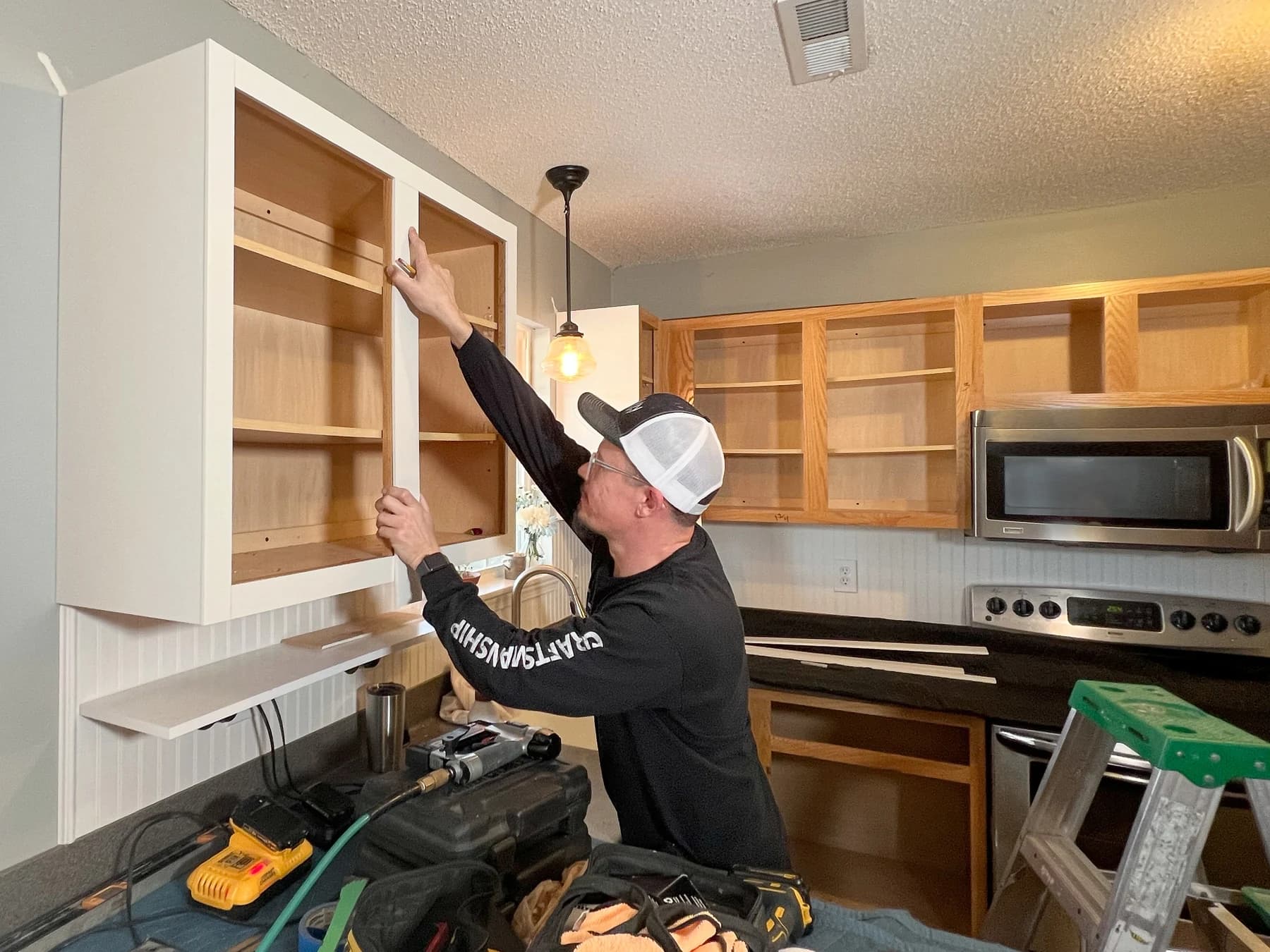
Yes, you can often replace kitchen cabinet doors while keeping the existing boxes. The new doors need to fit the openings, hinges, and surrounding cabinets. You also need a plan for the drawer fronts, visible frames, exposed ends, and trim, because replacing doors alone leaves those surfaces as they are.
That last part is easy to miss when you are looking at door samples. A new white Shaker door may be exactly what you want. Hang it on a worn oak cabinet with an exposed oak end panel, though, and you have updated one piece of a much larger picture.
Before ordering anything, decide whether you want a few replacement parts or a coordinated change across the kitchen. Both are reasonable goals. They call for different work.
When replacing only the doors makes sense
A limited door replacement is worth exploring when the boxes are sound, the layout works, and you still like the surrounding finish.
Perhaps one door is damaged. Perhaps the existing fronts are an ornate style you no longer want, but the cabinet frames and sides are in good condition. In those situations, a compatible door may solve the problem without resurfacing everything else.
Look beyond the closed doors before making that decision. Open a few cabinets and stand at the end of each run. Check the face frames, end panels, toe kicks, molding, and any exposed shelving. Are those surfaces in a finish you want to keep? Can a new door coordinate with them convincingly?
If the answer is yes, investigate a limited replacement. If the answer is no, price a more complete scope before spending money on separate pieces.
Matching an older stained finish deserves particular care. Wood species, natural variation, finish chemistry, and aging can all influence the result. An exact match should never be assumed from a color name or a phone photo. Crown's custom cabinetry page explains why photos or an existing door are useful when discussing a match.
Door replacement and cabinet refacing are different scopes
Companies sometimes use these terms loosely. Ask what is included in the proposal rather than relying on the label.
| Part of the kitchen | Replacing doors only | Crown premium refacing |
|---|---|---|
| Cabinet boxes | Retained | Retained when suitable |
| Doors | Replaced | Replaced |
| Drawer fronts | Separate unless included | Replaced |
| Exposed frames and cabinet sides | Existing finish remains unless separately treated | Covered with quarter-inch real-wood refacing material |
| Trim and molding | Existing pieces remain unless included | Coordinated new pieces are part of the reface |
| Hinges and decorative hardware | Scope depends on the proposal | New decorative hardware and hidden soft-close hinges |
| Drawer boxes and storage accessories | Separate work | Optional improvements based on the cabinet and project |
That is why a low online door price cannot stand in for a quote to update the entire kitchen. It may be a price for one unfinished component, without hinges, drilling, finishing, fitting, drawer fronts, or installation.
For Crown's complete process, see cabinet refacing in Kansas City.
Door style and overlay are separate decisions
Door style describes the face of the door: for example, a Shaker profile, raised panel, or slab.
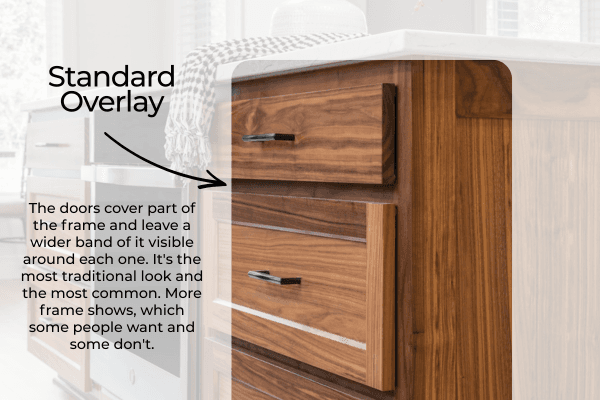
Overlay describes how far the door covers the cabinet frame. It affects how much frame you see between neighboring fronts. A Shaker door can appear in different cabinet constructions, so choosing that style does not automatically produce the tight spacing in a full-overlay kitchen.
Crown premium refacing uses standard half-inch overlay. You can choose the door style, wood, and finish within that refacing system, but should not expect a full-overlay, inset, or frameless result from it.
Some other cabinet systems permit changes in overlay when the frame, hinges, and clearances allow. That possibility does not make every existing kitchen convertible, and it is not a promise about Crown's refacing offering. If a different overlay is central to your design, bring it up in the custom cabinetry conversation.
Use Crown's overlay guide alongside the cabinet door profiles so you can separate the door shape you like from the way it fits the cabinet.
What has to be measured before new doors are made?
The visible opening is only part of the measurement.
A properly planned order accounts for the cabinet construction, intended overlay, door thickness, hinge type and location, neighboring fronts, and room for the door to swing. Paired doors also need the correct relationship to each other.
An existing door can be a useful reference when you are keeping the same setup. If you are changing the hardware or fit, copying its dimensions without checking the rest may reproduce an old problem or create a new one.
Pay special attention to cabinets beside walls, appliances, inside corners, and decorative trim. A door that fits while closed can still hit something when opened. A pull that looks right on a sample can collide with the neighboring cabinet.
For a consultation, rough dimensions and photos are helpful. Final fabrication dimensions should come from the verified design. Keep the original doors available until the new components have been specified.
New doors do not fix every cabinet problem
An attractive new front can make a worn drawer mechanism less obvious. It cannot make the mechanism work better.
If a drawer drops off its track, catches halfway open, or cannot carry what you store in it, discuss the drawer box and slides separately. If a door will not stay aligned, inspect the hinge attachment and cabinet condition. Repeatedly tightening a screw into damaged material is not a long-term plan.
Refacing can be combined with suitable drawer upgrades and cabinet modifications. Those improvements should be written into the scope. A new drawer front and a new complete drawer are different line items.
The same distinction applies to storage. New doors preserve the existing openings. Turning a base cabinet into deep drawers, adding a trash pull-out, or creating better access to a corner requires another design decision.
Walk through one meal preparation routine before the appointment. Where do you bend, reach, move a stack of cookware, or fight a sticking drawer? Give the designer those specifics so the new kitchen works as well as it looks.
Choosing a finish for retained cabinet boxes
There are three useful approaches.
Match the surrounding cabinets. This is most appropriate for a limited repair or a small number of replacement parts. Compare a physical sample beside the existing finish before approving it.
Create a deliberate contrast. A different island finish or a separate cabinet element can look intentional. Random mismatches between new doors and worn frames usually look unfinished. Judge the whole cabinet run, including its exposed ends.
Update the visible surfaces together. If you want a new wood species or a substantially different color across the kitchen, a full reface can coordinate doors, frames, sides, and trim.
A painted finish can be a legitimate option for suitable cabinetry. Its performance depends on preparation, materials, application, and use. The practical question is whether you want to preserve the existing door style or change the doors and surrounding surfaces as part of a larger update.
Compare quotes using the same list of parts
Before comparing totals, have each proposal identify:
- The number of doors and drawer fronts.
- The wood or other specified material, door construction, and finish.
- Treatment of visible frames, ends, toe kicks, molding, and trim.
- Hinges, hinge preparation, pulls, and knobs.
- Any replacement drawer boxes, slides, or storage fittings.
- Measurement, delivery, installation, adjustment, and cleanup.
- Warranty coverage and care instructions.
For a full reface, use Crown's refacing cost guide as the starting point. A kitchen-wide refacing range should not be presented as the cost of replacing a few doors, and a component price should not be presented as the installed cost of a kitchen.
Helpful answers
Questions about replacing cabinet doors
Can I put Shaker doors on older cabinets?
Often, provided the boxes are suitable and the doors can be built to the required size and hardware configuration. The Shaker profile changes the look of the door. It does not by itself change the cabinet's construction or overlay.
Can I keep my existing hinges?
Possibly, if they are in good condition and compatible with the new doors. Check the intended fit and drilling requirements before ordering. Crown's premium refacing includes hidden soft-close hinges, so retaining old hinges is a different scope from that service.
Do the insides of the cabinets change during refacing?
The existing boxes remain. Do not assume the interiors, shelves, and drawer boxes will all be replaced or refinished. Ask the proposal to state what happens inside each cabinet and which upgrades are included.
Can I replace one damaged door?
It may be possible to make a compatible replacement. Matching the original profile and an aged finish can be more challenging than matching the size. Bring the damaged door or detailed photos so the options can be evaluated.