
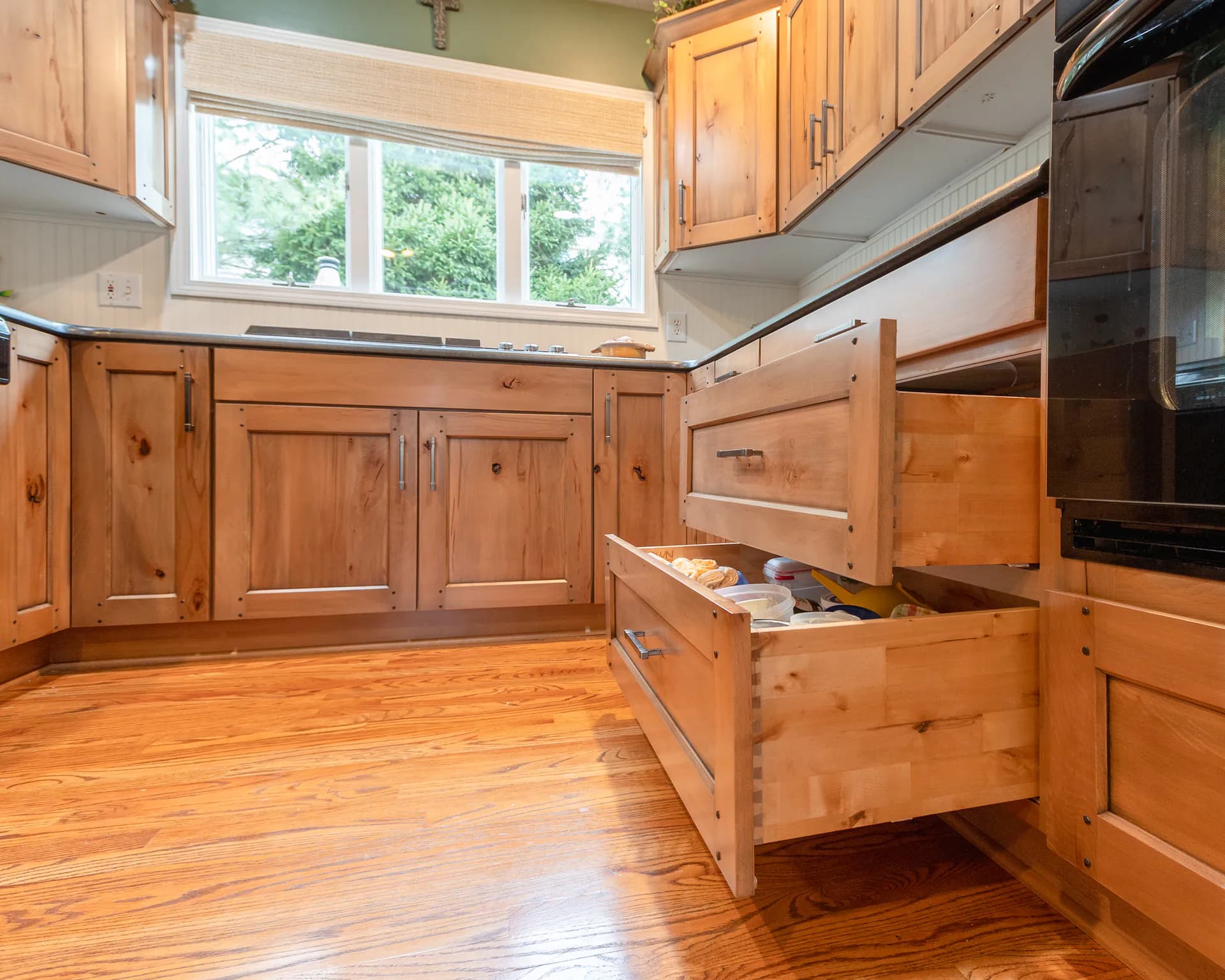
Many lower kitchen cabinets can be converted from doors and shelves to drawers while keeping the existing cabinet boxes. The cabinet must be sound, the opening must accommodate the new drawer system, and the slides need a suitable mounting surface. Interior pull-out shelves are another option when you want easier access while retaining the doors.
Both approaches can bring cookware and pantry items toward you. The better choice depends on what you store, how you use the cabinet, and how much of its exterior you want to change.
Start with the cabinet you dread opening. Is the problem a dark back shelf, heavy pans stacked on one another, a fixed divider, or a narrow door opening? Each points toward a different solution.
Drawers and pull-out shelves work differently
A drawer conversion replaces the cabinet's door arrangement with drawers that have their own visible fronts. You pull the front and the contents come forward with it.
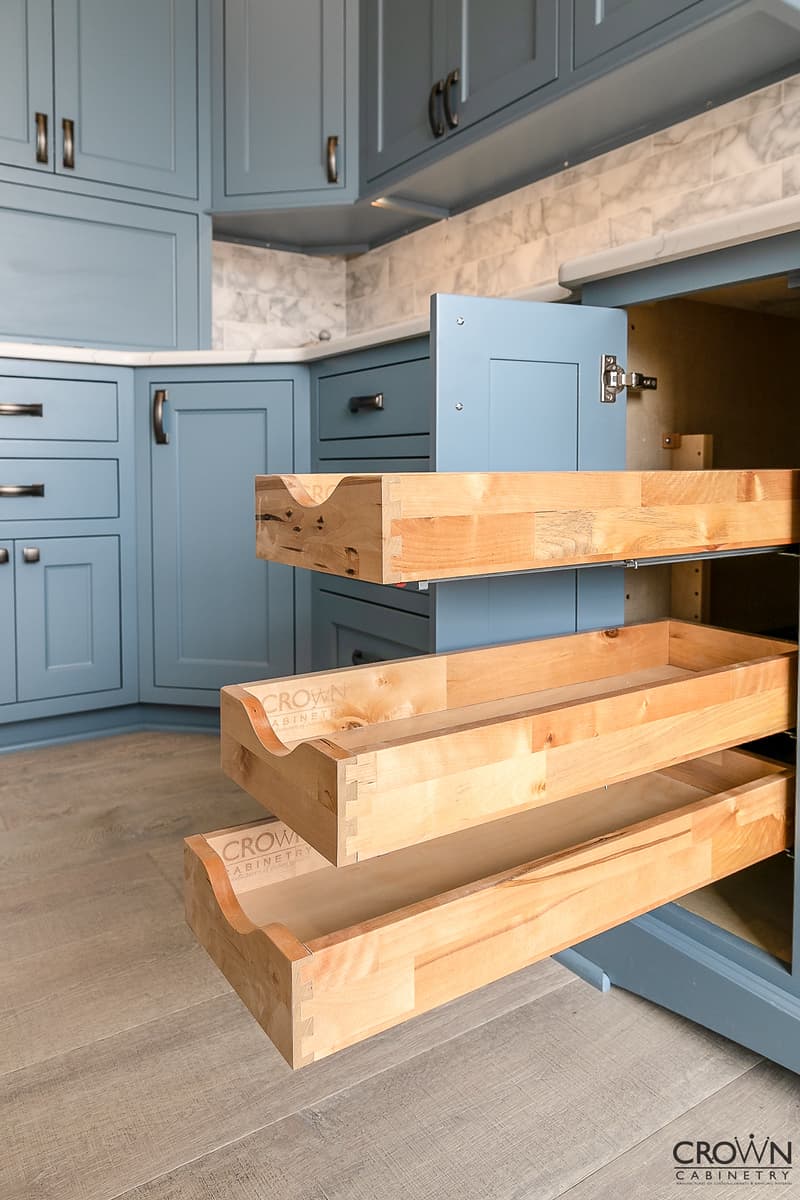
An interior pull-out shelf, sometimes called a roll-out tray, sits behind a cabinet door. You open the door, then slide out the shelf. It can improve access while keeping the existing appearance of the cabinet run.
| Consideration | Drawers with their own fronts | Pull-out shelves behind doors |
|---|---|---|
| Getting to an item | Open the drawer directly | Open the cabinet door, then the shelf |
| Exterior appearance | Changes from doors to drawer fronts | Can retain the existing doors |
| Useful applications | Frequently used cookware, utensils, dishes | Pantry supplies, larger items, selective retrofits |
| Main fit checks | Opening, drawer sizes, mounting, front alignment | Opening, hinge projection, door swing, shelf clearance |
| Interior space | Drawer sides and hardware use some space | Shelf sides and hardware use some space |
| Project scope | New fronts and fitting are part of the work | May involve fewer exterior changes |
Neither choice automatically adds physical capacity. The value is often making the space you already have easier to use. Ask about the finished interior dimensions, not just the width of the cabinet.
Which cabinets are good candidates?
A straightforward base cabinet with an open interior is often easier to adapt than a sink cabinet or a blind corner. Even then, the visible cabinet width does not tell the whole story.
Your cabinetmaker should check:
- The clear opening, including any face frame or center divider.
- Interior width, depth, and height at the actual installation points.
- The condition of the cabinet sides, bottom, and fastener locations.
- Fixed shelves, pipes, wiring, or other obstructions.
- Clearance from nearby doors, appliance handles, walls, and trim.
- Aisle space when the new drawer or pull-out is fully extended.
A cabinet can look wide from the front yet have a much narrower usable opening. Hinges may also project into the path of an interior pull-out. Those details should be resolved before choosing a storage accessory.
Do not assume a center stile or fixed shelf can simply be cut out. It may contribute to the cabinet's structure or countertop support. A professional should determine whether a modification is appropriate and how the cabinet will remain supported.
Choose the contents before the drawer heights
The easiest way to design disappointing storage is to order a stack of drawers and then discover your cookware does not fit.
Empty one problem cabinet and group what actually belongs there. Measure the tall and bulky pieces, including handles and lids. Then decide what should live together and what deserves a separate location.
Pots and pans
Large drawers can make cookware easier to see from above. Check the interior height with lids in place and the width across pan handles. Keep the everyday pieces where you can lift them comfortably, and discuss a separate location for infrequently used oversized cookware.
A lid divider or shallower companion drawer can prevent lids from turning into a loose pile. The right arrangement depends on the collection you own, not a perfectly styled showroom set.
Plates and bowls
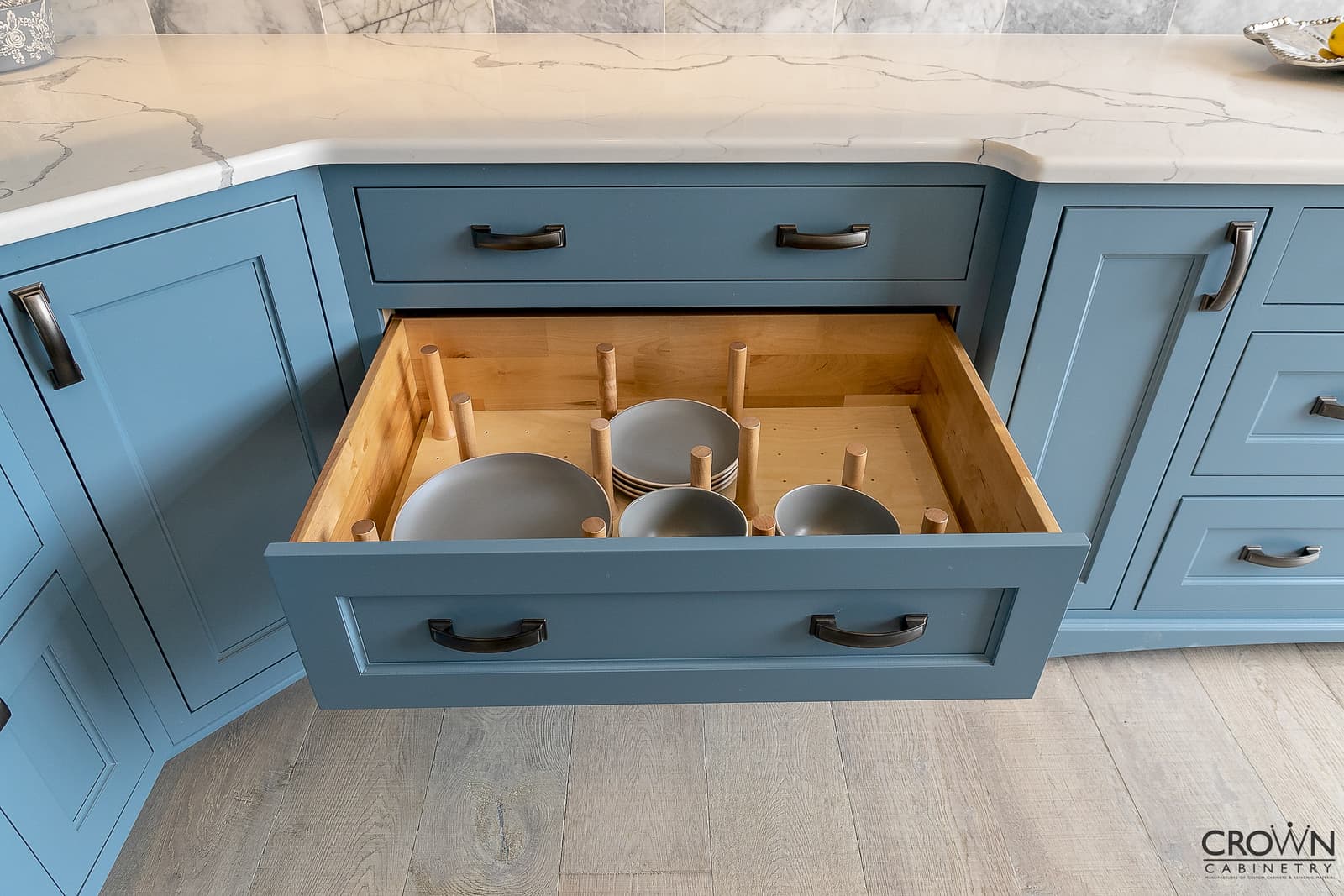
A drawer near the dishwasher can reduce the distance between unloading and putting dishes away. Check the largest plate diameter, stack height, loaded weight, and the space used by any peg system or divider.
If children or another family member will use the drawer, test the reach and effort involved. Accessible storage needs to work for the actual person using it.
Food containers and utensils
Deep storage is not always better. Small containers, lids, and tools can disappear into a tall drawer just as easily as they disappear onto a shelf. Shallower compartments or an internal tier may make better use of the opening.
Baking sheets and cutting boards
Vertical dividers may be more useful than a drawer conversion for these items. Standing trays on edge lets you remove one without lifting an entire stack. Keep the available cabinet height and the tray dimensions in the design conversation.
Small appliances
Check the appliance's weight, height, and intended storage position. A mixer lift and a deep drawer solve different problems. If you want to operate an appliance from a pull-out surface, ask about the specific hardware, load limits, stability, ventilation, and power requirements before treating that surface as a workstation.
Full extension and soft close are separate features
Full-extension slides allow the drawer to travel far enough forward to improve access to its rear contents. Soft close controls the closing motion. One does not automatically guarantee the other.
Blum's drawer runner guidance distinguishes full and partial extension and identifies load ratings for particular systems. That is why a quote should specify the hardware being used, rather than describe every drawer as heavy duty.
Ask what the manufacturer's rating covers, whether it includes the drawer's own weight, and what cabinet construction is required for installation. The drawer box, bottom, attachments, and slides need to work as a complete assembly.
Bring up cast iron, dish stacks, or bulk pantry supplies early. A drawer selected for lightweight utensils should not be assumed suitable for a much heavier load.
Sink cabinets and corners need their own plan
Plumbing, a disposal, water lines, and service access limit the space beneath a sink. A standard drawer stack usually will not fit that arrangement. A shaped organizer or selected pull-out may work, but it needs to fit the actual plumbing and preserve access for maintenance.
Corners have a different challenge: moving storage through an opening that may be narrower than the space behind it. A lazy Susan, a purpose-built blind-corner mechanism, or a custom configuration may be appropriate. Do not assume a standard rectangular pull-out will retrieve everything from a deep corner.
Photograph the inside of these cabinets with their doors open. Mark what you want to store and what you currently cannot reach. Those photos are more useful than a request to add drawers everywhere.
Can drawer conversions be part of cabinet refacing?
Yes. Crown's premium refacing service can include converting suitable base cabinets to deep drawers, replacing old drawer boxes and glides, and adding selected storage improvements.
Planning the storage during a reface lets the new drawer fronts coordinate with the kitchen's other doors, surfaces, and trim. It also lets the designer address the cabinet's function before finalizing the fronts.
If the current boxes cannot accommodate what you need, a selected new cabinet or a custom cabinetry project may be the better path. For example, a new island may provide the drawer widths and storage arrangement that a narrow existing cabinet cannot.
Retaining the right cabinets can be sensible. Spending heavily to force the wrong storage into an unsuitable opening may not be.
What affects the cost of a drawer conversion?
The number of cabinets is only the beginning. The price also depends on drawer dimensions, box construction, slides, finished fronts, cabinet modifications, and how the new parts must match the existing kitchen.
An interior pull-out that fits a sound, unobstructed opening may require less work than a full exterior conversion. That does not make every pull-out cheaper than every drawer. Custom dimensions, special hardware, or repairs can change the comparison.
Ask for the alternatives to be priced for the same cabinet: retaining the doors with interior trays, converting to drawers, or replacing the cabinet. Compare the usable result and included installation alongside the total.
If budget is limited, prioritize the storage you use every day. Fixing the pan cabinet beside the range may do more for your daily routine than adding an elaborate accessory to a rarely opened corner.
Helpful answers
Questions about adding drawers to existing cabinets
Will I have to remove my countertops?
Often not when the existing boxes stay and the modification does not disturb their support. Structural changes or selected cabinet replacement need a separate assessment. The installation plan should state how the countertop will be protected and supported.
Can I keep the doors and add drawers inside?
Yes, that is the basic idea of interior pull-outs. The doors must open far enough, and the shelf must clear the hinges and frame. Ask to see how the proposed setup operates before approving it.
Are drawers always better for someone who has trouble bending?
Drawers can bring contents forward, but the height, opening force, item weight, and user's reach still matter. Try comparable storage in person. A heavily loaded low drawer may still be difficult for someone to use.
Can I convert only one or two cabinets?
You can evaluate a limited project. The practical scope depends on cabinet suitability, finish matching, and the work required. Bring photos of the specific cabinets so Crown can discuss which changes make sense.